
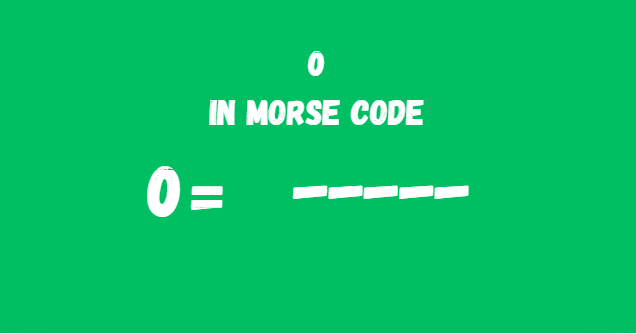
0 in Morse Code is written as —– (five dashes). It is one of the easiest numbers to recognize because it uses only long signals, making it stand out clearly in radio transmissions, flashlight signals, and tapping patterns. Morse code operators use the number 0 in everything from coordinates and call signs to emergency messages and aviation or maritime communication. Its simple pattern also makes it a great starting point for anyone practicing Morse code numbers and improving recognition speed.
This guide is designed to help you easily understand, recognize, and transmit the Morse code number 0. We will break it down into simple steps, look at the science behind the timing, and give you practical tips to practice like a pro. Let’s dive into the rhythm of the dash.
What Does the Morse Code Number 0 Look Like?
In Morse code, every number from 0 to 9 has a unique pattern made of five symbols. The number 0 is special because it is the only number composed entirely of dashes.
Visually, it is represented like this:
-----

How Does It Sound?
The visual representation is helpful, but Morse code is an auditory language. To truly understand it, you have to listen to it. When you tap out a dot, it sounds like a short, sharp beep or a quick tap. When you tap out a dash, it sounds like a longer, sustained tone.
Since the number 0 is five dashes, the sound is: Dah – Dah – Dah – Dah – Dah
It is a slow, heavy rhythm. If you were to say it out loud, you would say “Dah” five times with a short breath between each one. You can listen to audio samples of this online to get the feel for the tempo. It sounds very deliberate compared to the snappy, staccato rhythm of the number 1 or the number 2.
The Logic Behind the Code: Why Five Dashes?
You might be asking, “Why is zero five dashes? Why not two dots and three dashes?” There is actually a clever logic to how Morse code numbers are designed. Morse code was designed to be efficient. The most common letters in the English language (like ‘E’ and ‘T’) have the shortest codes (one dot or one dash). As we get into numbers and less common punctuation, the codes get longer.
Numbers in Morse code follow a countdown/count-up pattern:
- 1 is dot-dash-dash-dash-dash (
.----) - 2 is dot-dot-dash-dash-dash (
..---) - 3 is dot-dot-dot-dash-dash (
...--) - 4 is dot-dot-dot-dot-dash (
....-) - 5 is dot-dot-dot-dot-dot (
.....) - 6 is dash-dot-dot-dot-dot (
-....) - 7 is dash-dash-dot-dot-dot (
--...) - 8 is dash-dash-dash-dot-dot (
---..) - 9 is dash-dash-dash-dash-dot (
----.) - 0 is dash-dash-dash-dash-dash (
-----)
The Science of Timing: Mastering the Rhythm
Reading Morse code isn’t just about knowing the order of the symbols; it is about time. If you tap five dashes but you hold them for too short a time, they will sound like dots. If you leave the gaps too long, the listener will think you have finished the word and are starting a new one.
Here is the golden rule of timing for the number 0:
- The Dash Length: A dash must be exactly 3 times longer than a dot. If a dot is 1 second, a dash is 3 seconds. (In real usage, it is much faster, but the ratio is what matters).
- The Intra-Character Gap: The space between the dashes inside the number 0 must be the length of 1 dot.
- The Total Duration: Because 0 is five dashes, it takes a long time to send compared to other numbers.
Let’s do the math:
- You have 5 dashes.
- Each dash is 3 units of time. (Total for dashes: 15 units).
- You have 4 gaps between those 5 dashes.
- Each gap is 1 unit of time. (Total for gaps: 4 units).
- Total time for the number 0 = 19 units of time.
This makes 0 the longest single digit to send. That is why it is so important to be patient when sending it. Don’t rush!
How to Send the Number 0 (The Tapper Method)
Whether you are using a professional telegraph key, a smartphone app, or just tapping on a table, the physical action of sending 0 is a great way to build muscle memory.
Here is a simple step-by-step guide to practice:
- Find your surface: Use a practice button, a mouse click, or a hard tabletop.
- Close your eyes: This helps you focus on the rhythm rather than the visual movement.
- The Action (The Dash): Press down and hold. Count “One Mississippi, Two Mississippi.” Release.
- The Pause: Count a quick “One.” Release pressure completely for a split second.
- Repeat: Press and hold again (“One Mississippi, Two Mississippi”).
- Sequence: Do this five times total.
Tapper Exercise: Try this sequence right now:
- Tap… (hold for a moment) … Release … (quick pause) … Tap … (hold) … Release … (quick pause) … Tap … (hold) … Release …
If you did it five times, you just sent a zero!
Remember, the most common mistake beginners make is making the dashes too short. If your dashes sound like heavy dots, the person listening might get confused. Think of a dash as a long, luxurious note. Draw it out.
How to Receive and Identify 0
Listening to Morse code is like learning to hear music. When you are first starting, all the beeps might sound the same. However, once you start recognizing patterns, 0 will stand out clearly.
Here is how to spot it:
- Look for the “Heavy” Sound: Since 0 has no dots, it lacks the sharp, crisp edges of other numbers. It sounds deep, thumping, and slow.
- Count the Dashes: When you hear a long beep, start counting on your fingers. If you get to five long beeps without hearing a single short beep, it is definitely 0.
- Watch for the Pattern: If you are reading a paper tape or watching a light flash, look for the sequence of five long lines. It looks like a fence made of long posts.
Comparison Drill: To train your ear, compare the sound of 5 (.-----) versus 0 (-----).
- Number 5 starts with a sharp “Dit” followed by long “Dahs”.
- Number 0 is all “Dahs”. Hearing that difference between the starting “Dit” and the starting “Dah” is the key to distinguishing these two.
Visualizing and Mnemonics: Tricks to Remember
Sometimes, our brains need a little help to lock in a new piece of information. Here are a few memory tricks (mnemonics) to help you remember that 0 equals five dashes.
The “Zero is Empty” Visualization: Imagine a zero is a big empty bucket. Because it is empty, there are no “dots” (which can look like tiny pebbles) inside it. It is just the big, hollow rings of the dashes.
The “O” Shape: If you connect the bottoms of the five dashes, they start to form a long wave or a circle. Think of the dash as a rounded shape, similar to the letter O and the number 0.
The Spoken Mnemonic: When learning Morse code, many people use the “Dah” and “Dit” sounds. For 0, simply say to yourself: “Zero is heavy, zero is slow, five big dashes in a row.”
Using a Flashlight to Send Number 0
You don’t need a radio to practice Morse code. A simple flashlight is one of the best tools for visual learning, especially for numbers.
Here is how to send 0 with a light:
- The Dot: A quick flash (blink and it’s gone).
- The Dash: A sustained beam. Leave the light on for a second.
- Sending 0: Turn your flashlight ON (count “one, two”), turn it OFF (count “one”), turn it ON (count “one, two”), turn it OFF. Repeat this five times.
Pro Tip: When using a flashlight, make sure your “off” pause is distinct but not too long. If you turn the light off for 5 seconds between dashes, the person watching will think you are signaling different letters. The pause between dashes should be just a quick flicker of darkness.
Common Mistakes and How to Avoid Them
Even experienced operators make mistakes. Here are the most common errors when dealing with the number 0 and how to fix them.
Mistake 1: The “Running Dash”
- The Problem: You send the dashes too close together, so it sounds like one incredibly long tone instead of five separate ones.
- The Fix: Focus on the gap. Consciously lift your finger or key between each dash. Ensure that tiny “unit of silence” exists.
Mistake 2: The “Rushed Zero”
- The Problem: You are sending code fast, and your dashes get shorter and shorter until they sound like dots.
- The Fix: Slow down. Good Morse code is about consistent rhythm, not speed. If you can’t keep the dashes 3x longer than the dots, you are going too fast. Practice speed later; focus on accuracy now.
Mistake 3: Confusing 0 with Letters
- The Problem: In Morse code, some letters have dashes. For example, the letter ‘M’ is two dashes (
--), and the letter ‘O’ is three dashes (---). - The Fix: Context is key. Also, count the duration. A number is always 5 symbols long. If you hear three dashes, it is the letter O. If you hear five, it is the number 0.
Where is the Number 0 Used in Real Life?
Learning Morse code is fun, but is it useful? Absolutely. Here are common places where the number 0 is used today:
- Aviation: Pilots and air traffic controllers sometimes use Morse code identifiers for radio beacons (NDBs). While numbers are less common in identifiers than letters, understanding them is part of the required knowledge.
- Amateur Radio (Ham Radio): When operators exchange signal reports (like “599”), they often send numbers. The number 0 is used in “RST” reports to indicate readability or signal strength if a station is perfectly unreadable or has zero tone (though 5 is usually the goal, 0 has its place).
- Emergency Signals: In survival situations, you might need to transmit a coordinate or a frequency. Frequencies often contain zeros (e.g., 7.000 MHz).
- Assistive Technology: Morse code is used by people with disabilities to communicate via computers. Knowing the number 0 allows for full numeric expression.
Practice Quiz: Test Your Knowledge
Ready to see if you’ve got it? Try this quick quiz. Don’t worry; we’ll provide the answers below.
Question 1: Which of the following represents the number 0? A) .—– B) —– C) ….. D) -….
Question 2: How many “units of time” is a single dash worth? A) 1 unit B) 2 units C) 3 units D) 5 units
Question 3: If you are tapping the number 0, how many separate times must you press the key? A) 1 time (hold it down) B) 3 times C) 5 times D) 10 times
Question 4: True or False: The gap between dashes in a number 0 should be longer than the dashes themselves. A) True B) False
Answers:
- B (Five dashes).
- C (A dash is 3 units).
- C (You press 5 times, once for each dash).
- False (The gap should be the length of one dot, which is shorter than the dash).
Frequently Asked Questions About Morse Code Zero
To help you understand even more, here are answers to the most common questions people ask about the letter 0 in Morse code.
Is 0 the longest Morse code character?
It is the longest number, consisting of 5 symbols. However, some punctuation marks and rare accented characters can be longer. But among standard numbers and letters, 0 is one of the “heavyweights” in terms of duration.
Can I use Morse Code 0 in text messaging?
Yes! While you wouldn’t typically type it out for a normal conversation, there are Morse code keyboard apps and filters that translate your text into dots and dashes. Sending “—–” is a fun way to say “zero” or “null” to a friend who knows the code.
Why do I hear some people say “Dah” differently?
Pronunciation varies slightly by region and operator preference. Some say a deep “Daaaah,” others say a crisp “Daw.” As long as the timing (the length of the sound) is correct, the pronunciation doesn’t matter. The key is consistency.
What if I mix up 0 and O (the letter O)?
The letter O is three dashes (---). The number 0 is five dashes (-----). If you listen carefully, the number 0 will sound significantly longer—almost like the speaker is dragging it out. In written text, if the context is a phone number or a frequency, you can assume it’s a zero. If it is a word, it’s likely the letter O.
How can I practice without buying equipment?
You can use free online Morse code translators. Type in the number 0 and listen to it played back at different speeds (Words Per Minute). Start slow (5 WPM) to clearly hear the distinct dashes, then gradually increase the speed as your brain learns to process the rhythm faster.