
SOS Morse Code is the world’s most recognized emergency signal. Its simple pattern of three dots, three dashes, and three dots makes it easy to send, identify, and remember during critical situations.
The signal has been used for more than a century across ships, aircraft, rescue operations, and survival situations. Even today, SOS remains a universal call for immediate help.
What Is SOS Morse Code?
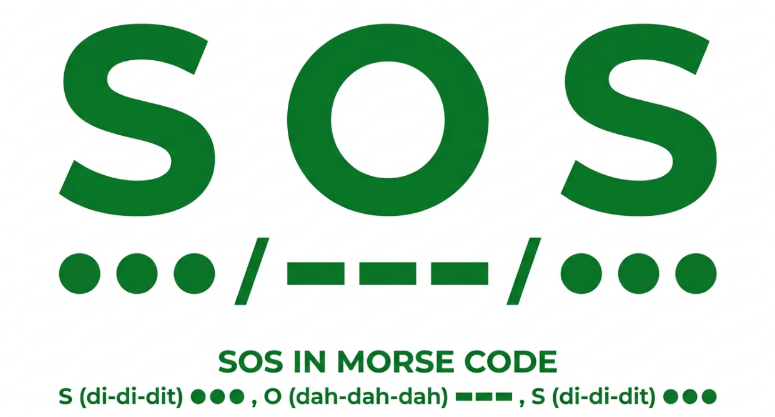
SOS Morse Code is an internationally recognized distress signal represented by the pattern ··· — ···. It is designed to be simple, clear, and easy to transmit through sound, light, radio, or visual signals. Unlike many people believe, SOS is not an abbreviation. It was chosen because its Morse Code sequence is easy to recognize and difficult to confuse with other messages. The pattern can be repeated continuously, making it effective during emergencies when communication options are limited.

SOS Morse Code Pattern
SOS is written as three dots, three dashes, and three dots in Morse Code. The sequence creates a distinct rhythm that stands out from regular messages.
| Character | Morse Code |
|---|---|
| S | ··· |
| O | — |
| S | ··· |
Complete SOS Pattern:
··· --- ···Does SOS Stand for Save Our Souls?
Many people assume SOS means “Save Our Souls” or “Save Our Ship.” These phrases became popular after the signal was already in use. In reality, SOS was never intended to represent specific words. The signal was selected because its Morse Code pattern is short, symmetrical, and easy to transmit under pressure.
Over time, several backronyms were created, including:
- Save Our Souls
- Save Our Ship
- Send Out Succor
- Save Our Sailors
Why Was SOS Chosen as the Distress Signal?
SOS was selected because of its simplicity and reliability. During emergencies, operators needed a signal that could be transmitted quickly and recognized immediately.
Several factors made SOS the preferred choice:
- Easy to remember
- Fast to send
- Distinct rhythm
- Works with sound and light signals
- Difficult to misunderstand
These advantages helped SOS become the global standard for emergency communication.
History of SOS Morse Code
SOS became the official international distress signal in the early 20th century. Before its adoption, different countries used various emergency signals, which often created confusion.
The Earlier Distress Signal: CQD
Before SOS, many ships used CQD to request urgent assistance. However, CQD was more difficult to transmit and recognize.
CQD generally meant:
- CQ = Calling all stations
- D = Distress
International Adoption of SOS
SOS was officially approved during the 1906 International Radiotelegraphic Convention and became active worldwide in 1908. The new signal offered a simpler alternative to CQD. Maritime operators quickly adopted it because of its clear and memorable structure.
SOS and the Titanic Disaster
The RMS Titanic helped bring global attention to SOS when operators used both CQD and SOS during the sinking in 1912. The disaster highlighted the importance of standardized emergency communication. Afterward, SOS became even more widely recognized across the world.
SOS During the World Wars
Military and civilian operators frequently used SOS during World War I and World War II. Ships, submarines, aircraft, and rescue units relied on Morse Code communication. The SOS signal helped coordinate rescue efforts and emergency responses during wartime operations.
How to Send SOS Morse Code
SOS can be transmitted using many different methods. The key requirement is maintaining the correct pattern of three dots, three dashes, and three dots.
Sending SOS with Sound
Short sounds represent dots, while longer sounds represent dashes.
Examples include:
- Whistle blasts
- Horn signals
- Beeping devices
- Radio transmissions
- Tapping sounds
Example:
Beep Beep Beep
Beeeeep Beeeeep Beeeeep
Beep Beep Beep
Sending SOS with a Flashlight
A flashlight can transmit SOS using short and long light flashes.
Signal timing:
| Signal Type | Duration |
|---|---|
| Dot | 1 second |
| Dash | 3 seconds |
| Pause | 1 secon |
Sending SOS with Visual Markings
Large visible SOS markings can help rescuers identify a person from the air or a distance.
Common methods include:
- Writing SOS in sand
- Arranging rocks into letters
- Creating snow markings
- Using bright-colored materials
- Making ground signals in open fields
Sending SOS Through Radio Communication
Radio operators transmit SOS using Morse Code over emergency frequencies.
This method has historically been used by:
- Ships
- Aircraft
- Coast guards
- Rescue teams
- Amateur radio operators
How Modern Emergency SOS Systems Work
Today’s technology has expanded the ways emergency messages can be sent. Many devices now include dedicated SOS features.
Smartphone Emergency SOS
Modern smartphones can contact emergency services and share location data automatically.
Features often include:
- Emergency calling
- GPS location sharing
- Medical information access
- Emergency contact notifications
Satellite SOS Devices
Satellite communicators allow distress messages to be sent from remote locations.
These devices are popular among:
- Hikers
- Mountaineers
- Sailors
- Expedition teams
- Outdoor adventurers
GPS Emergency Beacons
Emergency beacons transmit distress signals and location information directly to rescue authorities.
Common types include:
| Device Type | Main Use |
|---|---|
| EPIRB | Maritime emergencies |
| PLB | Personal emergencies |
| ELT | Aircraft emergencies |
How SOS Signals Are Received
Emergency signals must be detected quickly to increase the chances of rescue. Different technologies help emergency responders locate people in distress.
Maritime Rescue Monitoring
Quick Answer: Ships and coastal rescue centers continuously monitor emergency communication channels.
When an SOS signal is detected:
- The signal is verified.
- Nearby vessels are notified.
- Rescue authorities are contacted.
- Search operations begin.
Satellite Signal Detection
Satellite systems relay SOS alerts from remote locations to rescue coordination centers.
The process usually follows these steps:
- Distress signal transmitted.
- Satellite receives signal.
- Ground station processes information.
- Emergency responders are notified.
- Rescue mission is launched.
Why SOS Is Still Important Today
Although digital communication has advanced significantly, SOS remains relevant because it is simple and universally recognized.
Benefits include:
- No language barrier
- Easy to memorize
- Works with multiple communication methods
- Recognized worldwide
- Effective during equipment failures
Examples of SOS Morse Code in Real Life
SOS can be transmitted in many practical situations. Recognizing these examples helps people identify distress signals quickly.
Audible SOS Examples
Quick Answer: SOS can be heard through repeating short and long sounds.
Examples:
- Three whistle blasts
- Three horn blasts
- Three short beeps followed by three long beeps
- Tapping patterns on walls or pipes
Visual SOS Examples
Quick Answer: Visual signals use light or physical markings to display the SOS pattern.
Examples:
- Flashlight signals
- Signal lamps
- Ground markings
- Reflective mirror flashes
- Emergency flare patterns
Written SOS Examples
Quick Answer: Written SOS markings can alert rescuers when electronic communication is unavailable.
Examples include:
- SOS in sand
- SOS in snow
- SOS using stones
- SOS using logs or branches
Tips for Practicing SOS Morse Code
Regular practice helps people recognize and send SOS quickly during emergencies.
Simple practice methods include:
- Listening to Morse Code audio recordings
- Using flashlight drills
- Practicing whistle patterns
- Trying Morse Code apps
- Repeating the rhythm daily
SOS Morse Code Chart
Quick Answer: The SOS pattern combines the Morse Code letters S and O into one recognizable emergency sequence.
| Letter | Morse Code |
|---|---|
| S | ··· |
| O | — |
| S | ··· |
| Full SOS | ··· — ··· |
Why SOS Morse Code Still Matters Today
SOS Morse Code remains one of the most reliable emergency signals because it is simple, universal, and easy to recognize. Even with modern communication technology, it can still help people request assistance when phones, internet connections, or other systems fail. Advanced emergency tools have improved safety, but SOS continues to play an important role in survival situations. Whether someone is stranded at sea, lost in a remote location, or affected by a natural disaster, the SOS Morse Code pattern provides a clear way to signal distress.
One of the biggest strengths of SOS is its flexibility. The signal can be transmitted using sound, light, radio communication, whistles, mirrors, flashlights, or visual ground markings. Because the pattern is recognized internationally, rescue teams can quickly identify it regardless of language barriers. Its lasting value comes from its simplicity and reliability. When conventional communication methods are unavailable, SOS remains a trusted distress signal that can help rescuers locate people faster and improve the chances of a successful rescue operation.
The Lifesaving Value of Knowing SOS Morse Code
Knowing how to send and recognize SOS Morse Code can make a significant difference during an emergency. It provides a simple method of communication when other options are unavailable. A basic knowledge of SOS allows individuals to react more effectively in unexpected situations. The signal requires no special equipment and can be transmitted using everyday items such as flashlights, whistles, or tapping sounds.
Benefits of knowing SOS Morse Code include:
- Signaling for help quickly during emergencies
- Communicating when mobile networks are unavailable
- Improving safety while hiking, camping, boating, or traveling
- Helping rescuers identify a distress situation faster
- Providing a backup communication method during disasters
Although modern emergency technology continues to evolve, SOS Morse Code remains a practical survival skill. Its long history in maritime communication, aviation safety, and search-and-rescue operations shows why it is still recognized as one of the most effective distress signals in the world.
Frequently Asked Questions
These FAQs answer the most common questions about SOS Morse Code, its meaning, and how it is used during emergencies. They also help clarify several myths surrounding this famous distress signal.
What does SOS mean in Morse Code?
SOS is a universal distress signal written as ··· — ··· in Morse Code. It is used worldwide to indicate that a person, vessel, or aircraft needs immediate assistance.
Does SOS actually stand for “Save Our Souls”?
No. SOS does not officially stand for “Save Our Souls” or “Save Our Ship.” These phrases were created later, while the original SOS signal was chosen because its Morse Code pattern is simple, clear, and easy to recognize.
How can someone send an SOS without a radio?
SOS can be transmitted using several methods, including flashlight signals, whistle blasts, tapping sounds, mirrors, or large ground markings. Any method that can represent three short signals, three long signals, and three short signals can be used to send an SOS Morse Code distress call.
Can modern smartphones send SOS signals?
Yes. Most modern smartphones include an Emergency SOS feature that can contact emergency services, share GPS location data, and notify emergency contacts. Some newer devices can even send SOS messages through satellite communication when cellular service is unavailable.
How do rescuers detect SOS signals?
Rescuers can detect SOS signals through radio monitoring systems, satellite emergency beacons, smartphone emergency alerts, visual distress signals, and emergency communication networks. Once the signal is identified, rescue teams use location data and available information to coordinate a response.