Language is the bridge between human minds. We use words to share ideas, make decisions, and agree on plans. While we usually speak words aloud, what happens when we cannot speak? What happens when we are in the dark, separated by distance, or hiding in silence? This is where the beauty of Morse code shines.
Morse code is not just a collection of random dots and dashes; it is a language of sound, light, and time. It does not rely on written letters or spoken words. Instead, it uses short and long signals to exchange information. While many people start by learning the alphabet, others focus on entire functional words. Among these, “Yes” is one of the most frequent, popular, and essential words to know. Decisions are confirmed, questions are answered, and agreements are sealed using this powerful little word. In Morse code, “Yes” becomes a rhythmic pattern that can travel through walls, across oceans, or into the night sky using only a flashlight or a tap on a table.
This guide will help you master the word “Yes” in Morse code. We will explore what it looks like, how it sounds, and how you can use it in real-life situations ranging from fun games to emergency survival.
What Does “Yes” Mean in Morse Code?
If you are wondering what “Yes” looks like when converted into Morse code, here is the visual representation:
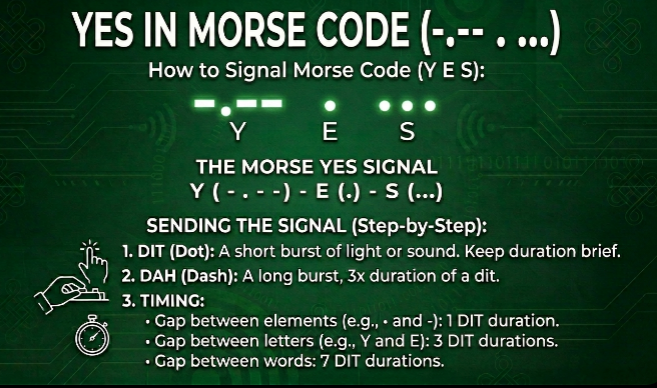
-.-- . ...
This pattern consists of short marks (dots) and long marks (dashes). To the untrained eye, it might look like a random collection of lines, but to someone who knows the code, it clearly spells out affirmation.
The Breakdown: To understand the pattern, we have to break the word “YES” down into its three individual letters:
- Y =
-.--(Dash dot dash dash) - E =
.(Dot) - S =
...(Dot dot dot)
When you combine them, you get the complete sequence: -.-- . ...
In the word “Yes,” the pauses are just as important as the signals.
- You send the Y.
- You pause.
- You send the E.
- You pause.
- You send the S.
How Do You Say Yes in Morse Code Without Speaking?
Morse code is versatile. You don’t need a radio or a telegraph machine to send it. You can say “Yes” without making a sound using your voice. You can use your body, your eyes, or simple tools.
Here are the most common non-verbal ways to send the signal for “Yes”:
- Flashing Light: Using a flashlight or a mirror reflecting the sun.
- Hand Movements: Waving a flag or moving your hand up (for a dash) or down (for a dot).
- Knocking Patterns: Tapping on a door, a wall, or a pipe.
- Blinking: Opening and closing your eyes to communicate if you cannot speak or move.
In all these methods, the rule remains the same:
- Short signals = Dots
- Long signals = Dashes
History is full of examples where this skill was vital. For instance, prisoners of war would tap Morse code on the walls of their cells to communicate with the person in the next cell. Simple messages like “Yes” and “No” allowed them to maintain hope and sanity.
Say Yes in Morse Code With a Flashlight
Using a flashlight is one of the most effective ways to send Morse code, especially at night or over long distances. If you are camping, hiking, or in an emergency situation, Morse code light signal can travel much farther than your voice.
To say “Yes” (-.-- . ...) using a flashlight, follow this pattern:
Step 1: The Letter Y (Dash dot dash dash)
- Dash: Hold the button down for a full second (Long flash).
- Dot: flick the light off and on quickly (Short flash).
- Dash: Hold the button down (Long flash).
- Dash: Hold the button down (Long flash).
Step 2: The Letter E (Dot)
- Dot: Flick the light quickly.
Step 3: The Letter S (Dot dot dot)
- Dot Dot Dot: Flick the light three times in rapid succession.
Why this works: This technique is incredibly useful during power outages or when you are trying to signal someone without alerting others nearby. Because light travels in a straight line, you can aim your signal directly at the person you want to communicate with.
How to Say Yes in Morse Code Using Sound
If you can see the person you are talking to, or if you are communicating over a radio, sound is the best method. But you don’t just say the letter names. In oral Morse code, we have special words for the signals to make them sound distinct.
- A dot is pronounced “dit”.
- A dash is pronounced “dah”.
So, when you say the word “Yes” in Morse code out loud, it sounds like a rhythmic song:
Y = Dah-dit-dah-dah E = Dit S = Dit-dit-dit
Put it all together:
“Dah-dit-dah-dah, [pause], Dit, [pause], Dit-dit-dit.”
Spoken smoothly, this creates a unique rhythm that trained listeners can recognize instantly. Radio operators and amateur radio enthusiasts (often called “hams”) practice this rhythm constantly to increase their speed and accuracy. They listen to audio recordings and tap along, training their ears to hear the word “Yes” without even thinking about it.
How Do You Say Yes in Morse Code Using Taps?
Tapping is perhaps the most “spy-like” way to use Morse code, but it is also very practical. You might find yourself in a situation where you cannot speak (perhaps you are hiding or in a library) and you need to answer a question.
You can tap on almost any surface to send “Yes”:
- A wall
- A wooden table
- A metal pipe (which carries sound well)
- A window
The Technique:
- Short tap = Dot
- Long drag = Dash
To tap “Yes”:
- Tap hard and drag slightly for the Y (Dash-dot-dash-dash).
- Make a single, sharp tap for the E (Dot).
- Make three rapid, sharp taps for the S (Dot-dot-dot).
Tapping “Yes” is a common trope in prison escape movies and adventure stories because it is a silent, secret way to communicate. It creates a bond between the sender and the receiver, a shared secret language that no one else in the room might understand.
What Is Yes in International Morse Code?
You might hear people talk about “International Morse Code” and wonder if it is different from the regular kind. The good news is: It is the same. Today, there is a single, unified standard used all over the world. Whether you are in the United States, Japan, France, or Brazil, the code for “Yes” is identical:
-.-- . ...
This uniformity is what makes Morse code so powerful. It breaks down language barriers. A sailor who speaks only Japanese can send a Morse code message to a radio operator who speaks only English, and they will understand each other perfectly.
Yes and No in Morse Code for Quick Replies
In communication, speed is often key. You don’t always have time to spell out long sentences. Learning just two words—”Yes” and “No”—can give you the ability to have a full conversation.
Yes = -.-- . ... No = -. ---
- N = Dash (
-) - O = Dash Dash Dash (
---)
Why the Letter S Matters in the Word “Yes”
The letter S is the final letter in “Yes,” and it plays a vital role in making the message clear.
The Morse code for S is three dots (...). This pattern is famous for a few reasons:
- It is easy to send: Tapping or flashing three times quickly is very simple.
- It is distinct: It sounds very different from the dashes used in the letter Y.
- It is the start of SOS: The international distress signal, SOS, is actually just three dots, three dashes, and three dots (
... --- ...).
Ending your “Yes” with the sharp triple-tap of the letter S acts like a period at the end of a sentence. It gives the word a crisp, final ending that prevents it from being confused with other words. Even in noisy or low-visibility conditions, that triple-dot rhythm cuts through the confusion.
Morse Code and Decision-Making
The word “Yes” is the ultimate tool for decision-making. In Morse code communication, time is often limited. If you are flying a plane or sailing a ship, you don’t have time for pleasantries. You need answers.
- “Is the runway clear?” -> Yes (
-.-- . ...) - “Did you receive the supplies?” -> Yes (
-.-- . ...) - “Is the patient stable?” -> Yes (
-.-- . ...)
Short words like “Yes” save time and reduce the chance of errors. Because the code for “Yes” is distinct and rhythmic, it is hard to mistake for anything else. A ship captain might send a message asking if a route is safe, and a simple reply of “Yes” (-.-- . ...) is all that is needed to proceed.
How Radio Operators Use “Yes” (And a Secret Pro Tip)
In professional radio communication, operators are always looking for ways to save time. While “Yes” (-.-- . ...) is the correct word, sometimes even four letters are too long.
Pro tip: Experienced radio operators often use the letter “C” to mean “Yes” or “Correct.”
- C =
-.-.(Dash dot dash dot)
If you hear a radio operator tap out -.-., they are confirming that the previous message was received and understood. It is a shortcut, a form of Morse code slang! This was especially common during wartime when speed was a matter of life and death and secrecy was essential. Sending a single “C” is faster than sending “Yes” or “Received.”
Morse Code in Emergency Training
You might think Morse code is obsolete, but emergency teams and militaries around the world still teach it. Why? Because technology can fail. Batteries die, satellites go offline, and radios break. But as long as you have a functioning body or a simple tool like a rock or a flashlight, you can send Morse code.
In emergency training courses, rescuers are taught to look and listen for simple patterns.
- Three short flashes might mean “S” or “Help.”
- The pattern for Yes (
-.-- . ...) is used to confirm that a trapped victim is alive and conscious.
Learning Morse Code Through Words
Many beginners try to memorize the Morse code alphabet by staring at a poster: A is .-, B is -..., and so on. This can be boring and difficult. A much better way to learn is by starting with whole words. Learning words like “Yes,” “No,” “Help,” and “Love” helps you understand the flow of the language.
- It teaches you rhythm: You learn how the letters flow together.
- It teaches you timing: You learn how long to pause between letters.
- It builds confidence: You can actually communicate something useful immediately instead of just spelling out random letters.
Teachers often use “Yes” as the very first word for students because it contains a mix of dashes and dots. It is complex enough to be interesting but short enough to memorize quickly.
How Our Morse Code Translator Helps
If you are struggling to get the rhythm right, don’t worry. You don’t have to do it alone. Modern technology makes learning easier than ever. A Morse Code Translator is a tool that instantly converts text into code.
How to use it to learn “Yes”:
- Type the word: Type “Yes” into the text box.
- See the code: The translator shows you
-.-- . .... - Hear the sound: This is the most important part. Click the “Play” button.
- Repeat: Listen to the “Dah-dit-dah-dah, dit, dit-dit-dit” rhythm over and over.
Why Visual and Audio Tools Work Seeing the code while hearing it helps your brain create a strong connection. It connects the visual symbols (dots and dashes) with the auditory rhythm (dits and dahs). This dual-learning approach makes it much easier to memorize the word “Yes” than just reading it off a page.
Why People Still Learn Morse Code Today
In an age of smartphones and instant messaging, why would anyone bother learning Morse code?
- Hobby Radio (Ham Radio): Thousands of people worldwide talk to each other using Morse code for fun. It is a community of hobbyists.
- Curiosity and History: People love learning how things worked in the past. It connects us to inventors like Samuel Morse.
- Survival Skills: Preppers and outdoor enthusiasts learn it as a backup communication method.
- Accessibility: Morse code can be used by people with disabilities to communicate using adaptive switches.
- Fun Challenges: It is often used in escape rooms, scavenger hunts, and geocaching.
Yes, No, and Other Common Morse Code Words
To help you on your journey, here is a quick list of the most common words alongside “Yes.” This is a great cheat sheet to keep on your phone.
- Yes:
-.-- . ... - No:
-. --- - Help:
.... . .-.. .--. - SOS (Distress):
... --- ... - Love:
.-.. --- ...- . - Hello:
.... . .-.. .-.. --- - OK:
--- -.-
Is 2 Yes in Morse Code a Real Term?
Sometimes, people search for “2 yes in Morse code.” This is usually a misunderstanding. There is no official Morse code symbol for the number 2 “Yes.” However, in informal communication, you might repeat the word “Yes” twice to show strong agreement, just like we say “Yes, yes!” in English.
In Morse, it would look like this: -.-- . ... / .-.-- . ... (Yes / Yes)
This repetition adds emphasis. It tells the receiver, “I really mean it!”
Frequently Asked Questions
Have questions about Yes in Morse code or how to send your own secret message? We’ve answered the most common questions below to help you master this romantic language quickly.
What is the Morse code for “yes”?
The Morse code for “yes” is -.-- . .... It is made up of the letters Y (-.--), E (.), and S (...).
Can “yes” be sent using light signals?
Yes, absolutely. You can use a flashlight or a mirror. A short flash is a dot, and a long flash (about one second) is a dash. Flash the pattern -.-- . ... to communicate “yes.”
Is “yes” the same in all Morse code systems?
Yes, “yes” is the same in International Morse Code, which is the standard used globally today. It allows people from different countries to understand each other without speaking the same language.
Why is “yes” easy to recognize in Morse code?
“Yes” has a distinct rhythm. The letter Y starts with a long dash, the E is a single sharp dot, and the S ends with three quick dots. This pattern (long... short... short, short, short) is very recognizable to trained listeners.
Can beginners learn “yes” quickly?
Yes, “yes” is one of the easiest words to learn because it is short and has a catchy rhythm. Many beginners use it to practice their timing and spacing before moving on to longer words.
Is “yes” used in real communication today?
Yes, it is used by amateur radio operators, pilots, and military personnel. It is also used in survival situations and by people practicing Morse code as a hobby.
Can I send “yes” without sound?
Yes. You can send “yes” by blinking your eyes, tapping on a surface, waving a flag, or flashing a light. Any method that can produce a short and long signal works.
Does “yes” have a special meaning in emergencies?
In emergencies, “yes” is used to confirm status. For example, if a rescuer asks if you are injured, tapping “yes” provides critical information.
What is the easiest way to practice “yes”?
The easiest way is to use a Morse code translator app. Type “yes” and listen to the audio playback. Then, try to tap or hum along with the rhythm until you can do it from memory.