
Morse code might seem like a forgotten language from the era of telegraphs and radio pioneers, but it remains a fascinating, useful, and vital skill in modern communication. Whether you are interested in amateur radio, preparing for emergency survival situations, or just looking for a fun new mental challenge, learning the digits is a great place to start.
Today, we are going to break down everything you need to know about the number 7. By the end of this guide, you will know exactly how to recognize it, write it, tap it out, and remember it forever. We will keep the language simple and the instructions clear so you can focus on mastering the rhythm.

What is the Morse Code for Number 7?
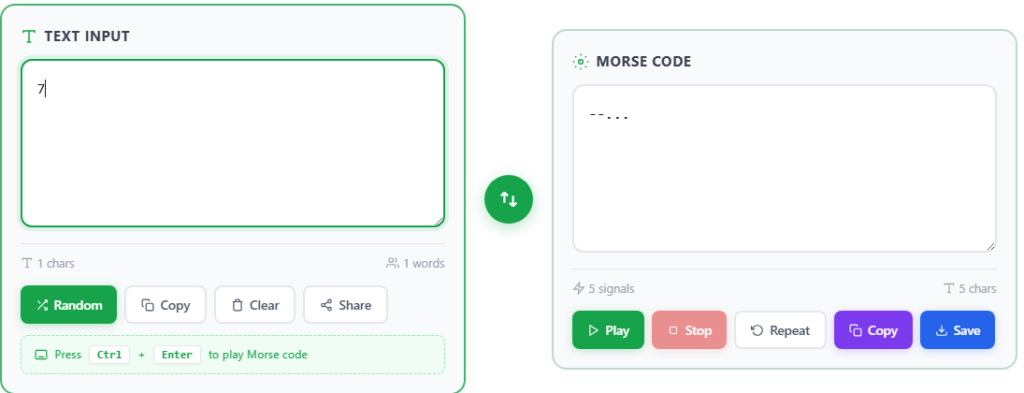
In the standard International Morse Code (which is used globally today), the number 7 is represented by a specific sequence of “dashes” and “dots.”
The Pattern: Dash, Dash, Dot, Dot, Dot Written Representation: --... Visual Symbol: — — · ·
How to Sound It Out: “Dah Dah Di Di Di”
Reading dots and dashes on paper is one thing, but Morse code is an auditory language. It is designed to be listened to. To really learn the number 7, you need to understand how it sounds.
In Morse code pronunciation:
- A Dash (—) is spoken as a long “Dah”.
- A Dot (·) is spoken as a short “Di” or “Dit”.
Therefore, the number 7 sounds like this: “Dah Dah Di Di Di”
Think of the rhythm. It starts heavy and slow with the two “Dahs,” and then finishes quickly with the three “Dis.”
- Mnemonic Tip: A great way to remember the sound for 7 is to think of the phrase “DAH-DAH-diddy-dit.” It has a bouncy, rolling rhythm that matches the signal perfectly.
The Logic Behind the Code: The “Dash Count” Rule
One of the best things about Morse code numbers is that they follow a logical pattern. You don’t have to memorize each number blindly; you can actually “calculate” them if you know the rule.
Here is the secret logic for numbers 1 through 9:
- Count the dashes.
- The number of dashes tells you what the digit is.
Let’s look at the sequence:
- Number 1 has 1 dash (
.----) - Number 2 has 2 dashes (
..---) - Number 3 has 3 dashes (
...--) - …
- Number 7 has 2 dashes (
--...)
Wait, that might seem confusing at first! If number 2 has 2 dashes, why does number 7 also have 2 dashes? Here is the second part of the rule: The code works from 1 to 5, then counts backwards from 6 to 9.
- Numbers 1-5: Dashes are at the end.
- Numbers 6-9 (and 0): Dashes are at the beginning.
So, for 7:
- It is in the “6, 7, 8, 9” group, so we start with dashes.
- To get a 7, we need a combination that relates to the number 3 (because 7 is the “mirror” of 3 in this sequence).
- Number 3 is three dots then two dashes (
...--). - Flip that around, and you get Number 7: two dashes then three dots (
--...).
The “Mirror” Trick: How 3 and 7 Are Best Friends
If you struggle to remember the pattern for 7, use the “Mirror Method.” This is one of the most effective memory aids used by Morse code students.
Look at these two side-by-side:
- Number 3:
...--(Three dots, two dashes) - Number 7:
--...(Two dashes, three dots)
Do you see it? Number 7 is the exact reverse of Number 3.
- 3 starts with dots and ends with dashes.
- 7 starts with dashes and ends with dots.
Mastering the Timing: How Long Does It Take?
Morse code is not just about the sound; it is about the timing. If you tap it too fast or too slow, it might be hard for others to understand. The standard timing rules (set by the ITU) help everyone stay on the same page.
Think of a “Dot” as 1 unit of time.
Here is the breakdown for the number 7 (--...):
- First Dash: 3 units.
- Second Dash: 3 units.
- Third symbol (Dot): 1 unit.
- Fourth symbol (Dot): 1 unit.
- Fifth symbol (Dot): 1 unit.
How to Practice Sending Number 7
The best way to learn is by doing. You don’t need expensive equipment. You can use a pen, a button on your phone, or even a flashlight.
Method 1: The Finger Tapper
Sit at a table with your hand resting on the surface.
- Lift your index finger.
- Tap down and hold for a split second longer (that’s the Dash). Do this twice.
- Tap… Tap…
- Pause briefly.
- Tap down and up quickly (that’s the Dot). Do this three times.
- Tap. Tap. Tap.
- Repeat until it feels natural.
Sequence: Long tap, Long tap, Short tap, Short tap, Short tap.
Method 2: The Flashlight (Visual Signaling)
This is perfect for practicing Morse code visually or for signaling across a distance.
- Turn your flashlight on and count “one Mississippi” (Dash).
- Turn it off for a quick blink (Gap).
- Turn it on again for “one Mississippi” (Dash).
- Turn it off for a quick blink.
- Now, flash it quickly three times (Dot, Dot, Dot).
- Turn it off completely to signal the end of the number.
Visual check: Long light — Long light — Short flash — Short flash — Short flash.
Differentiating 7 from 6 and 8
When you are starting out, it is easy to mix up the numbers in the 6-7-8 range. Here is how to tell them apart instantly:
- Number 6 (
-....): Starts with ONE dash. Think of it as the leader of the high numbers. - Number 7 (
--...): Starts with TWO dashes. It is the middle child. - Number 8 (
---..): Starts with THREE dashes. It is getting close to the end.
Interactive Practice Quiz
Ready to test yourself? Try to answer these questions without looking above.
Question 1: Which pattern represents the number 7? A) ..--- B) --... C) ---..
(Think about it: Option A is 2. Option C is 8. Option B is 7.)
Question 2: How do you speak the rhythm for number 7? A) Di Di Dah Dah B) Di Di Di Dah Dah C) Dah Dah Di Di Di
(Think about it: We start with the long sounds. The answer is C.)
Question 3: True or False: Number 7 is the reverse of Number 3. (Answer: True. 3 is ...-- and 7 is --....)
Frequently Asked Questions
We have compiled the most common questions beginners have about the number 7 in Morse code.
Why does 7 have two dashes and three dots?
It follows the International Morse Code standard for numerals. The system is designed to be symmetric. Numbers 1-5 count up in dots at the start, while numbers 6-9 count up in dashes at the start. The number 7 uses two dashes to signify its place in the sequence (6=1 dash, 7=2 dashes, 8=3 dashes).
Can I practice number 7 using just my mobile phone?
Absolutely! Many free apps simulate a telegraph key. You can also simply tap your finger on the table and record your voice to see if the rhythm sounds like “dah dah di di di.”
What if I confuse 7 with Q?
This is a common worry because letters can be long too! However, the letter Q is --.- (Dash Dash Dot Dash). Number 7 is --... (Dash Dash Dot Dot Dot). Listen closely to the end. If you hear three short sounds at the end, it is definitely a 7.