
Morse code might look like a secret language from a spy movie, but it is actually a beautifully logical system that anyone can learn. Whether you are preparing for a ham radio license, interested in emergency communication, or just looking for a cool new skill, understanding the digits is just as important as knowing the alphabet.
Today, we are going to break down everything you need to know about the number 8. By the end of this guide, you will know exactly what it looks like, what it sounds like, and how to tap it out perfectly every time.
What is the Morse Code for Number 8?
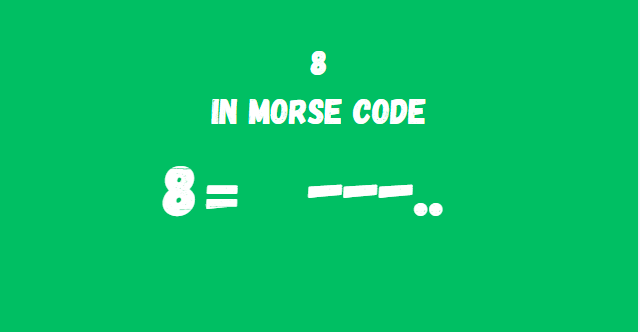
Let’s start with the most important part: the code itself. According to the International Telecommunication Union (ITU) standard, the Morse code for the number 8 is:
— — — · ·
In plain text format, this is often written as: ---.
Breaking Down the Rhythm: “Dah Dah Dah Di Di”
Reading Morse code on paper is one thing, but using it effectively requires you to understand its rhythm. Morse code is an auditory language. It relies on the length of the sound to convey meaning. For the number 8, the spoken mnemonic is: “Dah dah dah di di”
Why Mnemonics Matter
Think of a dash as a long note on a instrument and a dot as a short, staccato tap.
- Dah (—): A long, heavy sound. Think of it as the bass drum.
- Di (·): A short, quick sound. Think of it as a high-pitched snare tap.

The Science of Timing: How Long is Number 8?
To send Morse code correctly—whether you are using a telegraph key, a flashlight, or a smartphone app—you need to understand the timing rules. If you rush, a dot might look like a dash. If you go too slow, the message gets confusing.
Here is the standard timing breakdown for the number 8:
- The Dash (—): A dash is equal to 3 units of time.
- The Dot (·): A dot is equal to 1 unit of time.
- The Intra-Character Gap: The space between a dash and a dot within the same number is 1 unit of time.
The Math Behind Number 8
If we do the math, the total length of the number 8 is 15 units of time.
- 3 Dashes: 3 units x 3 = 9 units
- 2 Dots: 1 unit x 2 = 2 units
- 4 Gaps: 1 unit x 4 = 4 units
- Total: 9 + 2 + 4 = 15 units
The “Mirror Trick”: An Easy Memory Hack
One of the hardest parts of learning Morse numbers is memorizing the patterns for 0 through 9. However, there is a built-in cheat sheet in the code itself: Symmetry.
The number 8 is the perfect “mirror image” of the number 2.
- Number 2:
..---(Two dots, three dashes). - Number 8:
---..(Three dashes, two dots).
How to Tell 8 Apart from 7 and 9
When you are first learning, it is very easy to confuse the numbers that look similar. Here is how to distinguish 8 from its neighbors:
- Number 7 (
--...): Starts with two dashes and ends with three dots. It is “shorter” on the left side. - Number 8 (
---..): Starts with three dashes and ends with two dots. This is our target! - Number 9 (
----.): Starts with four dashes and ends with one dot.
The Rule of Thumb: Count the long dashes at the beginning.
- 2 dashes = 7
- 3 dashes = 8
- 4 dashes = 9
Hands-On Practice: Sending Number 8
The best way to learn Morse code is to do it. You don’t need expensive equipment. You can practice right now at your desk.
The “Tapper” Method
Imagine you have a telegraph key in front of you. We are going to simulate the action using your hand on a table.
- Relax your hand. Keep your wrist loose.
- The Dash (—): Tap the table and hold your finger down for a split second. Do this three times.
- Tap… (lift) … Tap… (lift) … Tap… (lift)
- The Pause: Wait a tiny beat (one unit of time).
- The Dot (·): Tap the table quickly and lift immediately. Do this twice.
- Tap … Tap
- The Result: You should hear: Thump… Thump… Thump… tap-tap.
Sequence Check: Dash → Dash → Dash → Dot → Dot.
The Flashlight Method (Visual Practice)
Morse code isn’t just for sound; it is for light, too. This is how ships used to talk to each other in the dark.
- Turn on a flashlight in a dark room.
- For the Dashes: Hold the button down for a quick count of “one, two, three.” Do this three times.
- For the Dots: Snap the light on and off instantly. Do this twice.
- Practice until the light feels rhythmic. It should look like a long pulse followed by a short staccato flash.
Practice Quiz: Test Your Knowledge
Now that we have covered the rhythm, the timing, and the memory tricks, let’s test what you’ve learned.
Question: Which of the following is the correct Morse code representation for the number 8?
A) ..--- B) ----. C) ---..
Think about it first…
. . .
The Answer: The correct answer is C) ---...
- Why A is wrong:
..---is the number 2 (the reverse of 8). - Why B is wrong:
----.is the number 9 (one too many dashes). - Why C is correct: Three dashes followed by two dots.
Frequently Asked Questions About Morse Code 8
We’ve compiled the most common questions beginners have about the number 8 to help clear up any confusion.
Why does 8 have three dashes and two dots?
This structure follows the logical progression of Morse code numbers. Numbers 1 through 5 increase in dashes as you go up (1 is dot-heavy, 5 is dash-heavy). Numbers 6 through 0 follow a reverse pattern. Number 8 sits higher in the sequence, meaning it has more dashes than dots, but not as many as 9 or 0. Specifically, it takes the pattern of the number 2 and flips it.
Can I use Morse code number 8 in a sentence?
Yes! Just like writing a normal number, you simply replace the digit ‘8’ with ---... For example, if you wanted to send coordinates “88”, you would tap: ---.. ---... Just remember to leave a slight pause (longer than the gap between symbols) between the two numbers so the receiver knows they are separate digits.
How fast should I be able to send Number 8?
Speed comes with time. When you are starting out, don’t worry about being fast. Focus on being accurate. If you send ---.. slowly but the spacing is perfect, you are doing better than someone who sends it fast but sounds messy. Start slow, and your muscle memory will eventually speed you up.
Is there a song that helps me remember Number 8?
Many people find that assigning the rhythm to a familiar beat helps. Since Number 8 is “Dah Dah Dah Di Di,” you can think of the opening beats of the theme song to Mission Impossible (which uses similar rhythmic structures) or simply count it out like a military drill: “One, Two, Three, Snap, Snap.”